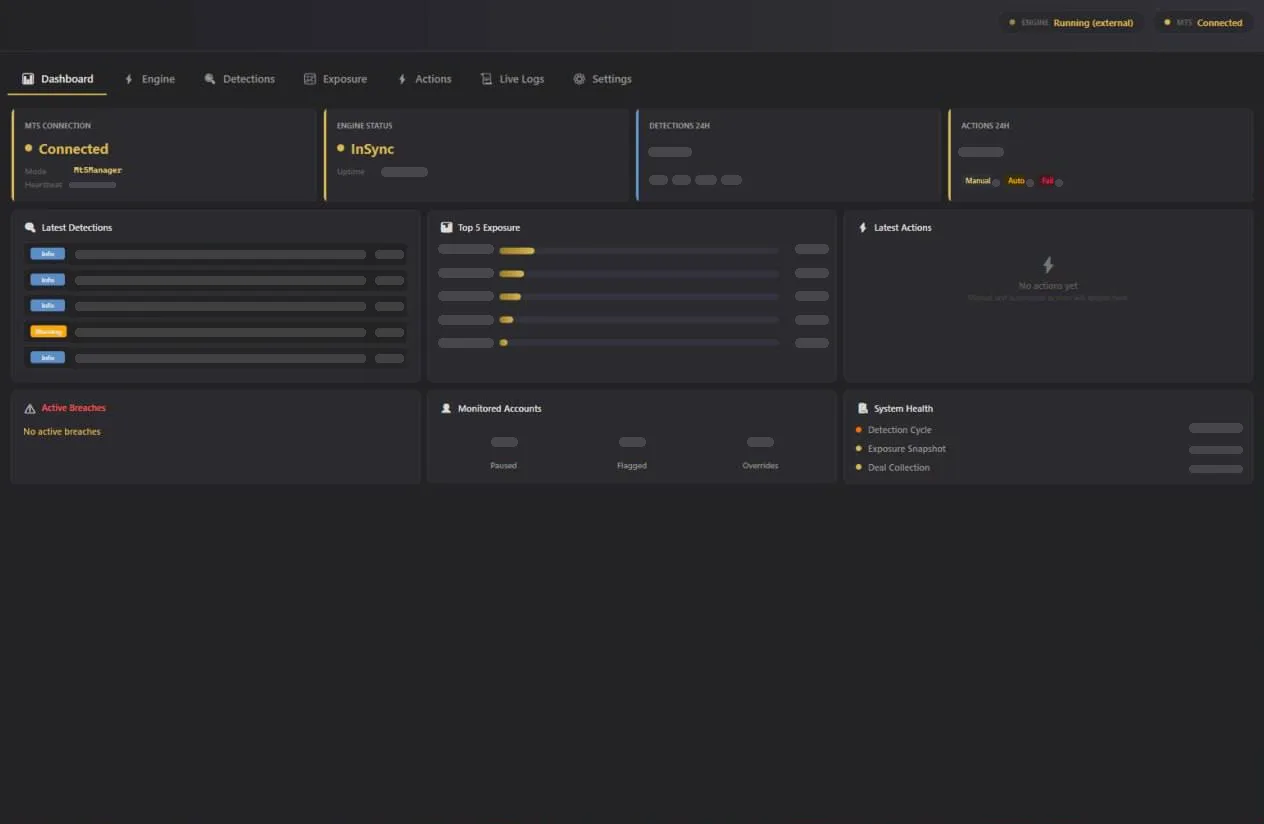
Engineering reference 01
Risk Supervision & Control Systems
The design of a risk supervision application: a rule-evaluation engine and an operator console for following and controlling it.
Engineering partner for trading businesses
Purpose-built software for proprietary trading firms, brokers and trading technology providers. C.G Solutions engineers risk supervision systems, MetaTrader 5 integrations, CRM data import and synchronisation, and automated reporting, around the constraints of each environment.
Our role
Every professional trading environment has its own risk policies, infrastructure, processes and integration constraints. Custom work is not sold as predefined packages: each system is specified, built and checked against agreed criteria for the operation it will serve.
In motion
A short film about what we do: engineering for trading businesses, and the software we publish.
The C.G Solutions mark, then the line “Trading. Reimagined.”
“A vision. High standards.” and “Precision in action”, at a trading desk.
ATLAS (“Analysis, at your fingertips”), then AxiomSuite™ Enterprise and SL-Locker (“Risk, under control.”).
“At the heart of your operations”, then “Solutions designed for your operations”: risk control, reporting and CRM integration, shown as an illustrative architecture.
“AI powering real-world solutions.”
The C.G Solutions mark.
Custom engineering
Five kinds of system for trading operations, and the applications operators use to run them.
Software that supervises trading accounts against configured risk policies: rule evaluation, limits, each account’s status against those rules, and the interfaces operators use to follow it.
Read more — Risk supervisionEngineering around MetaTrader 5 and the infrastructure that surrounds it: account and position data, trade history, and controlled exchange with other systems.
Read more — MT5 integrationTrading data read from MetaTrader 5 and carried into CRM and back-office applications: an initial import of accounts and their history, then incremental synchronisation, each run tracked until the receiving system has accepted it.
Read more — Data & CRMRecurring operational work turned into scheduled, observable processing: daily reports built from trading history, notifications, and the tracking that shows what ran, what did not, and when data was incomplete.
Read more — Automation & reportingSoftware that helps operators review trading activity: rule-based detection, exposure views, and alerts that state why they were raised.
Read more — Monitoring & detectionThe formats these systems are built in: operator consoles on the desktop, web interfaces and background services — designed around how the work is actually done.
Read more — ApplicationsSelected work
Each reference shows the kind of system we engineer, with its context and its limits. Interfaces are shown with sensitive fields masked.
Engineering reference 01
The design of a risk supervision application: a rule-evaluation engine and an operator console for following and controlling it.
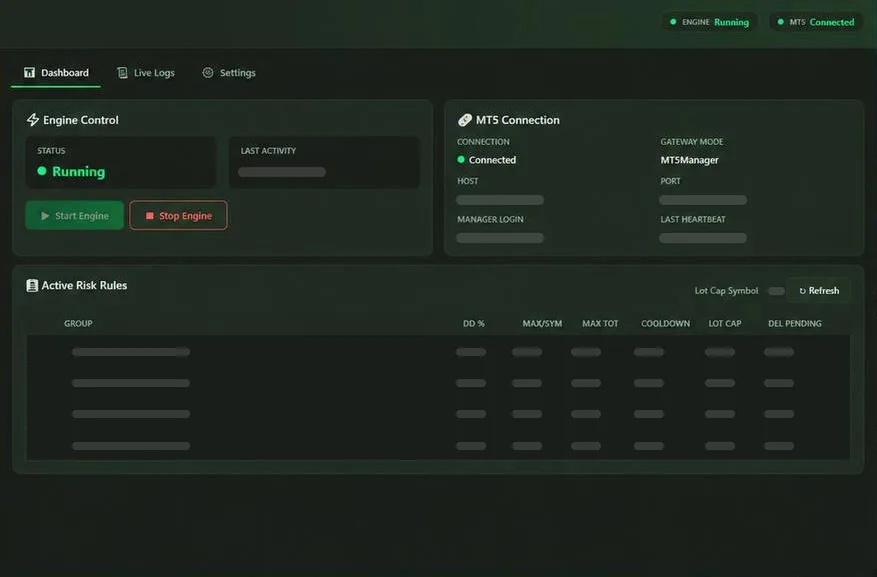
Engineering reference 02
The development of a monitoring application for trading operations: detection records, exposure views, and operator-facing interfaces for review and controlled actions.
Engineering reference 03
An integration designed to import accounts and their history, synchronise trading data and track its acceptance by the receiving system.
Engineering reference 04
A service designed to rebuild position lifecycles, consolidate exceptions to volume rules and produce a daily report whose processing state stays visible.
View reference — Daily Reporting and Operational Notifications
Our own software
Alongside custom engineering, C.G Solutions publishes its own tools. Each has one defined job and a page of its own.
 AxiomSuite™Risk supervision for MetaTrader 5Configurable risk supervision inside the MT5 workspace, in three distinct editions.View product
 ATLASChart Pattern IntelligenceGeometric chart-pattern recognition and structured analysis for MetaTrader 5.View product
 SL-LockerStop-loss reference monitoringA MetaTrader 5 utility that monitors stop-loss changes against a defined reference.View product
Products are operational tools. They do not guarantee trading results, regulatory compliance or protection against loss.
Approach
Each engagement starts with your operational requirements and the systems involved, and proceeds in stages.
What the operation needs, who uses the system, and which decisions it has to support.
The platforms, data, access rights and constraints the system must work within.
Components, interfaces, data contracts, failure behaviour and acceptance criteria, written down before implementation.
Built in stages you can review, rather than delivered in one piece.
Checked against those acceptance criteria, including how the system behaves when something fails.
Put into service with you, in agreed steps, with the means to observe it.
Provided when contracted, with a scope defined with you. Systems and rules evolve as operational requirements change.
Scope and timing are agreed per project; no stage is sold as a fixed package.
AI Project Architect
Explore a preliminary technical solution tailored to your trading operations with our AI-assisted project architect.
Complimentary and preliminary: not a quotation or a feasibility commitment.
Engineering practice
Four practices we design into every system, drawn from engineering work for trading operations. They are design practices, not guarantees.
A short description of the operation and what it must achieve is enough to begin.