
Engineering reference 02
Trading Monitoring & Detection Systems
A historical custom-engineering reference: the development of an application for monitoring trading activity — detection records, exposure views, and operator-facing review and control interfaces.
- Engineering disciplines
- Relevant use cases
- Reviewing trading activity against configured policies
- Following exposure by instrument and by group
- Giving operators one console for review
The engineering challenge.
Monitoring a trading operation means watching a large volume of activity for the small part of it that deserves attention — and presenting that part so that an operator can judge it quickly.
Several problems meet here: identifying potentially relevant events, presenting detection records so that they can be reviewed, showing how exposure is distributed, and offering operational actions without making them easy to trigger by mistake.
The engineering approach.
The work combined several disciplines.
- Detection
- Detection designed around policy rules and heuristics. The detections screen lists records with a type, a severity, a score and a summary, for operator review.
- Overview
- A dashboard bringing together counters, the latest detections and an exposure summary; the detections screen adds filters by type, severity and account.
- Exposure analysis
- An exposure screen designed to show positions aggregated by instrument and by group, with long, short, net and gross columns.
- Operator actions
- Interfaces designed for controlled actions: a typed confirmation on the most consequential control, and an action history view.
- Logs & diagnostics
- A live log view and system-health indicators, for operating and diagnosing the system.
Interface.
The application’s console: dashboard, detections, exposure, actions, engine, logs and settings.
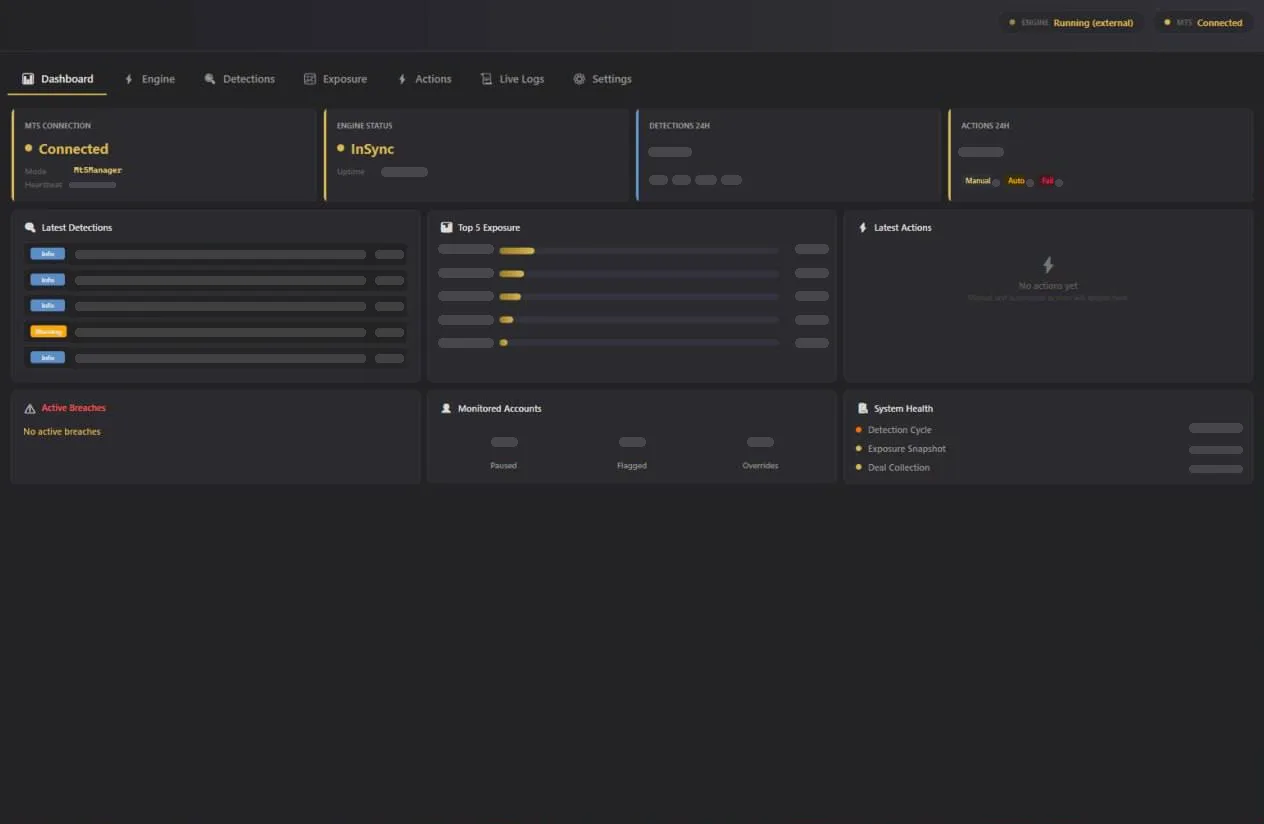
Dashboard — connection and engine status, recent detections, exposure and system health. 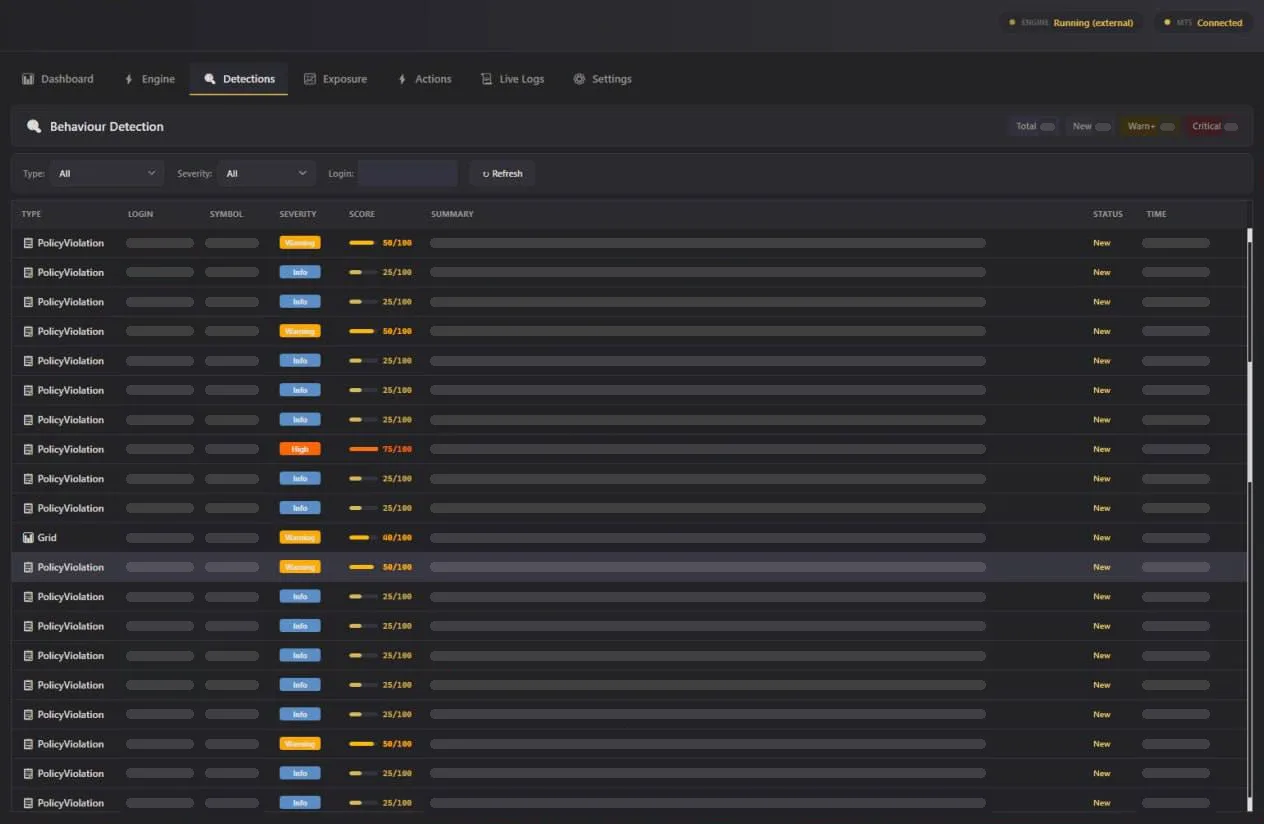
Detections — records with their type, severity and score, for operator review. 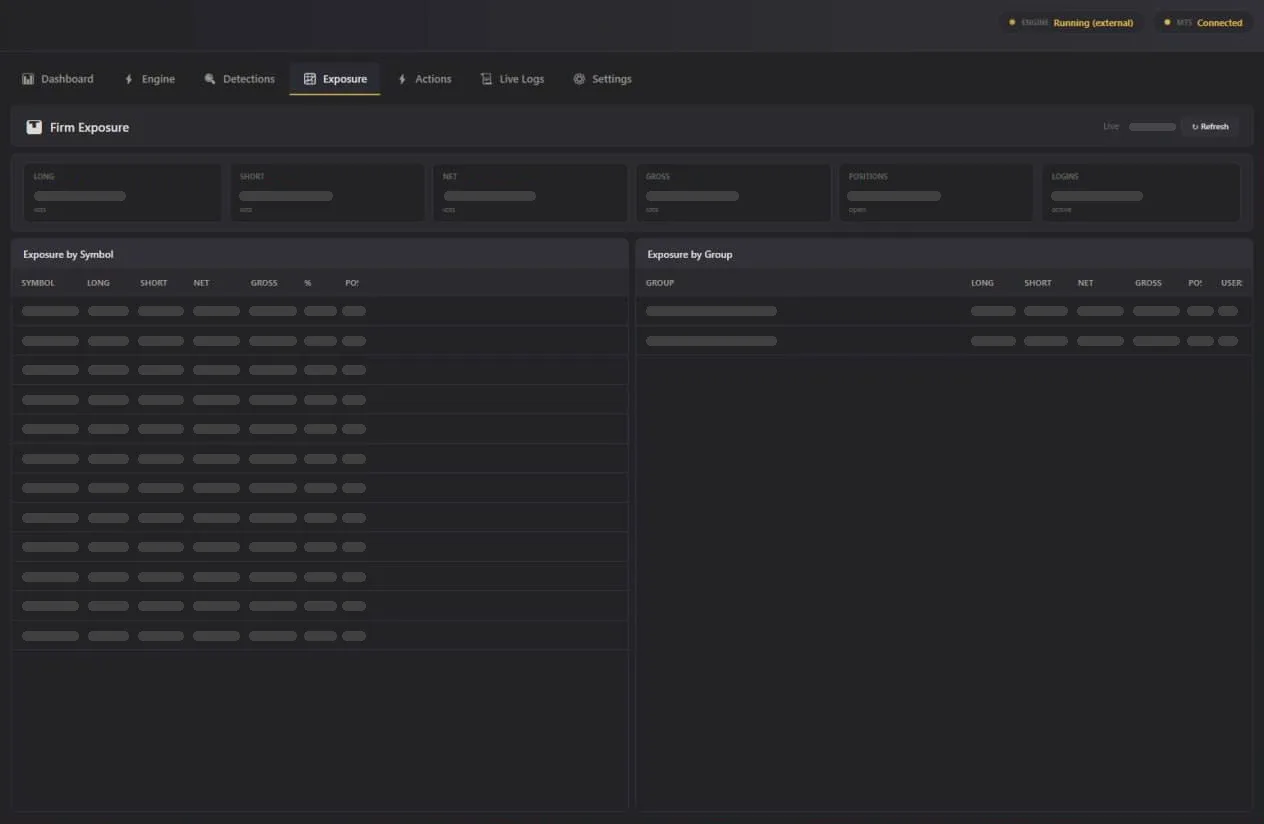
Exposure — positions aggregated by instrument and by group. 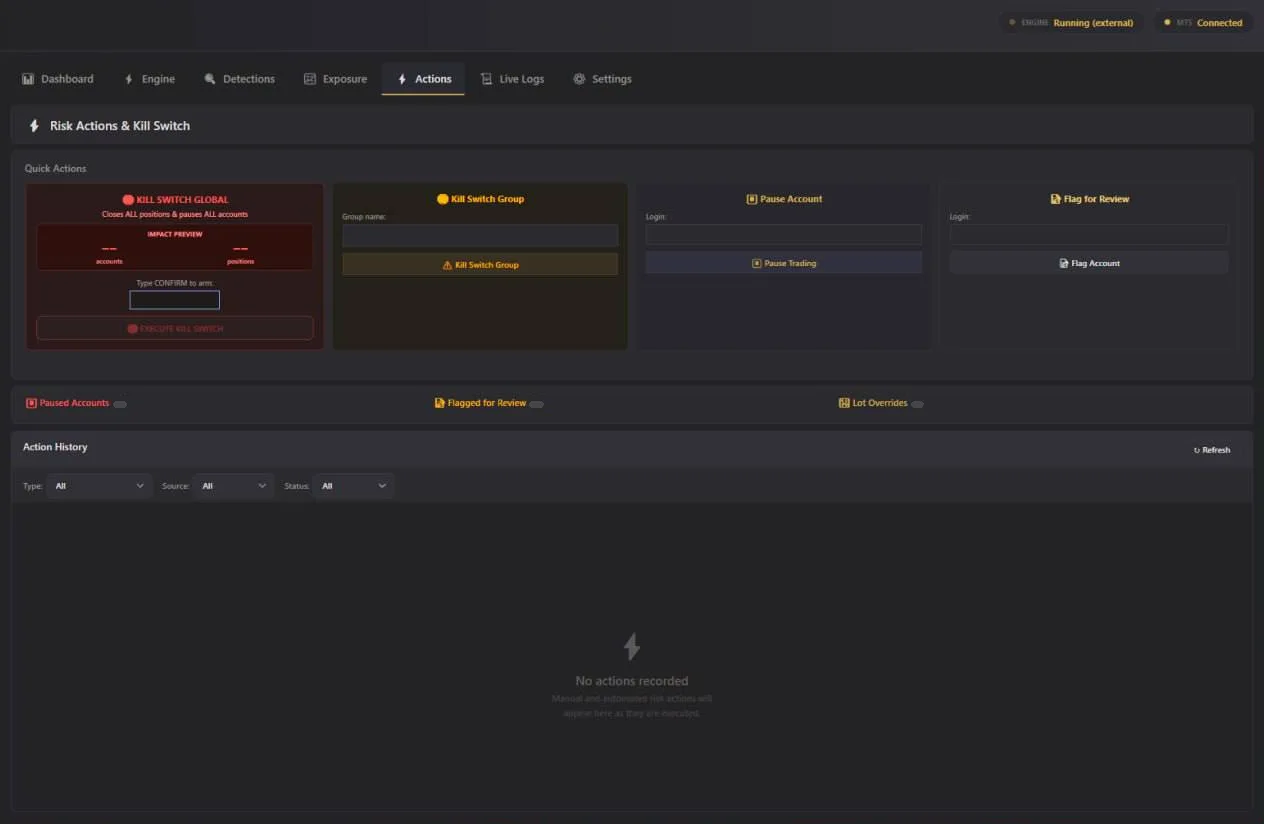
Actions — operator controls, a typed confirmation on the most consequential one, and the action history. 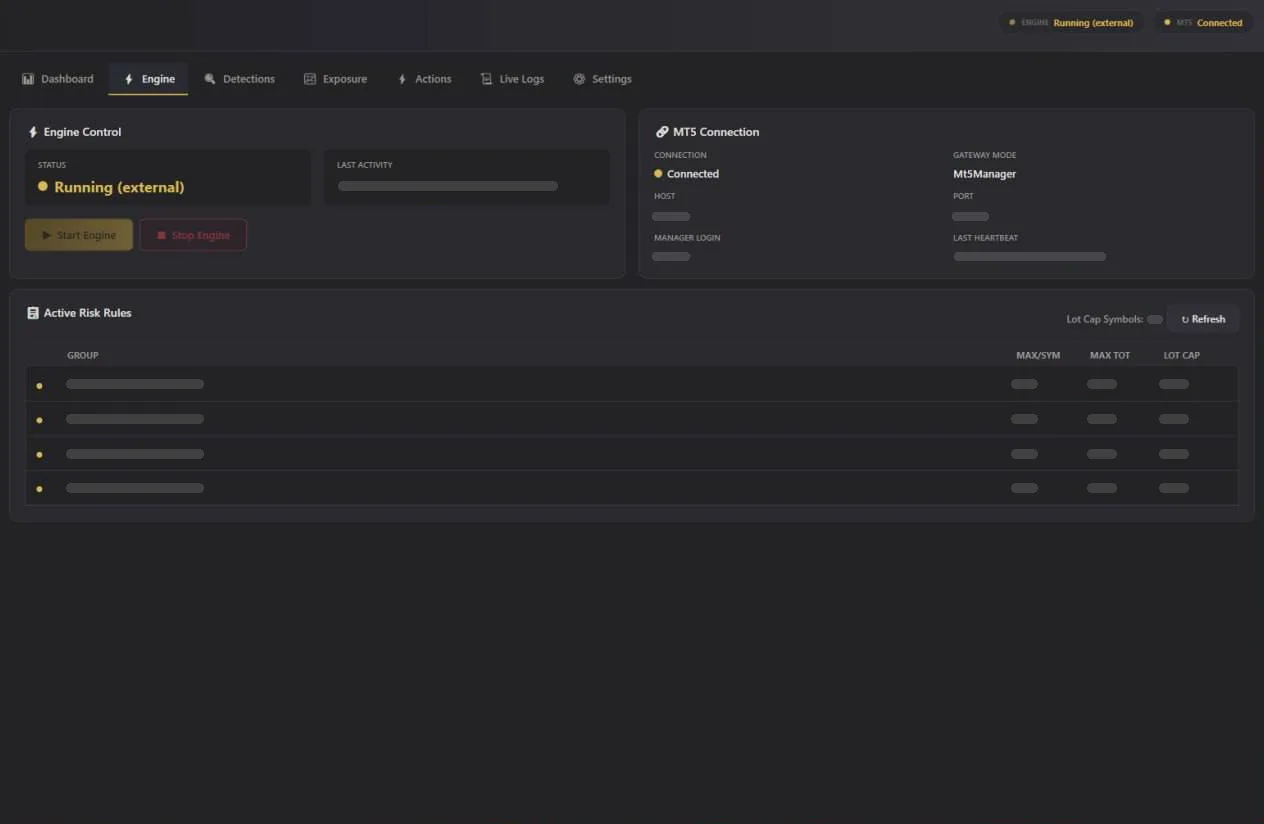
Engine — status, start and stop controls, platform connection and active rules. 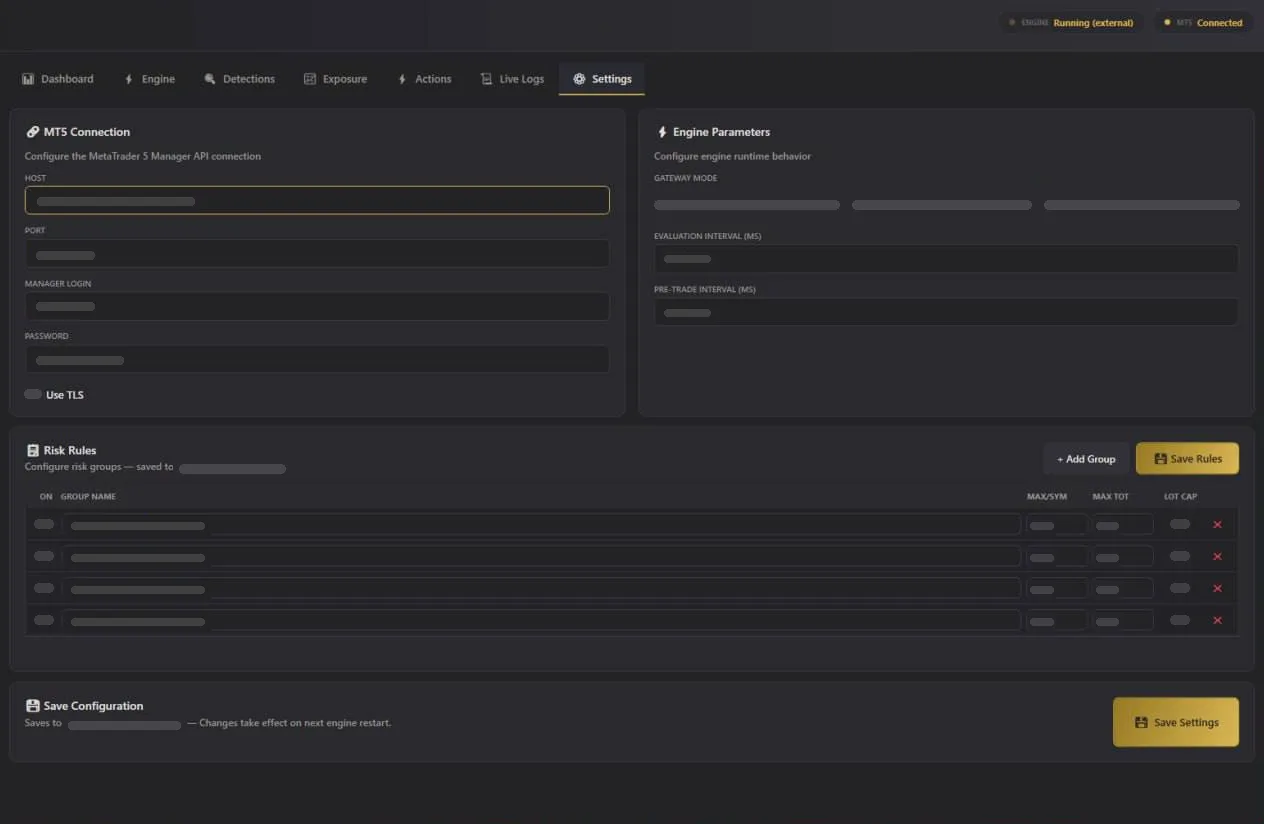
Settings — platform connection, engine parameters and rules per group. 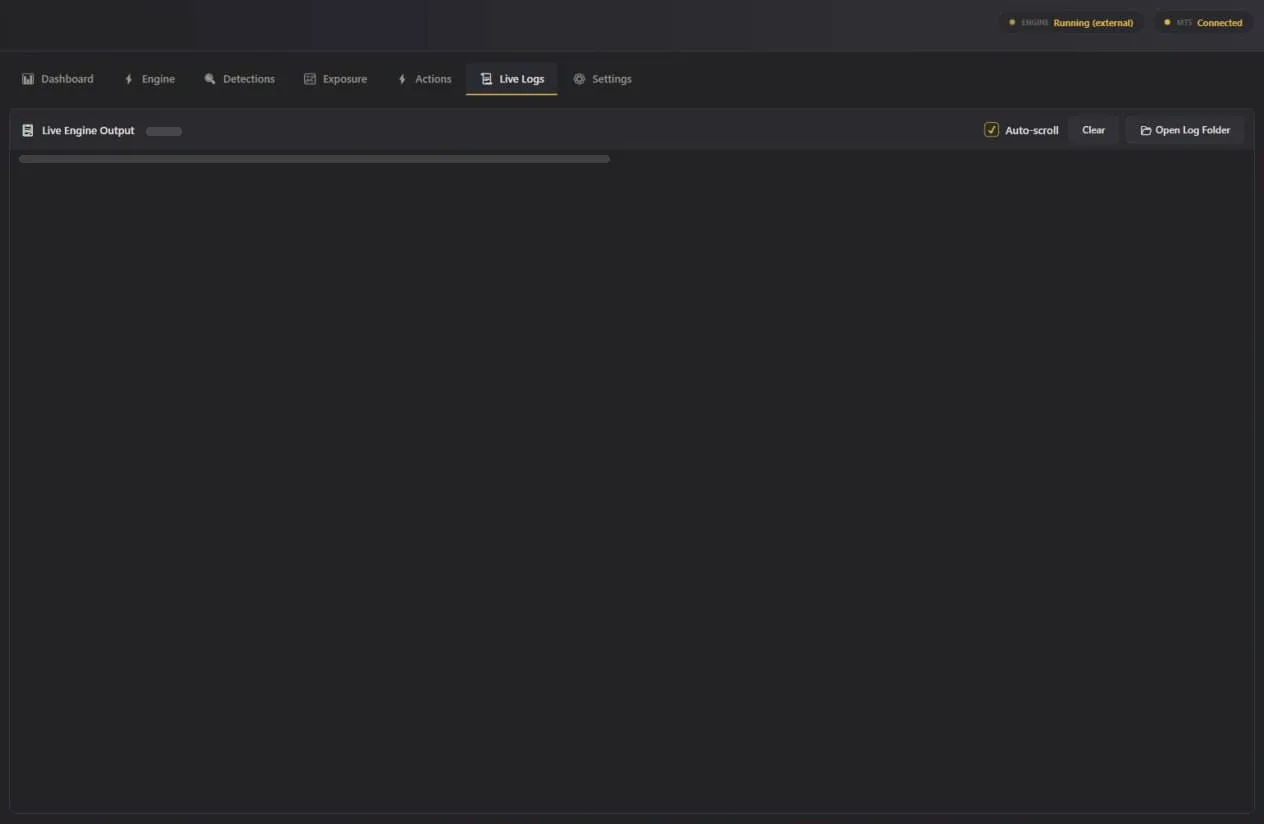
Live logs — the engine’s output, for diagnosis.
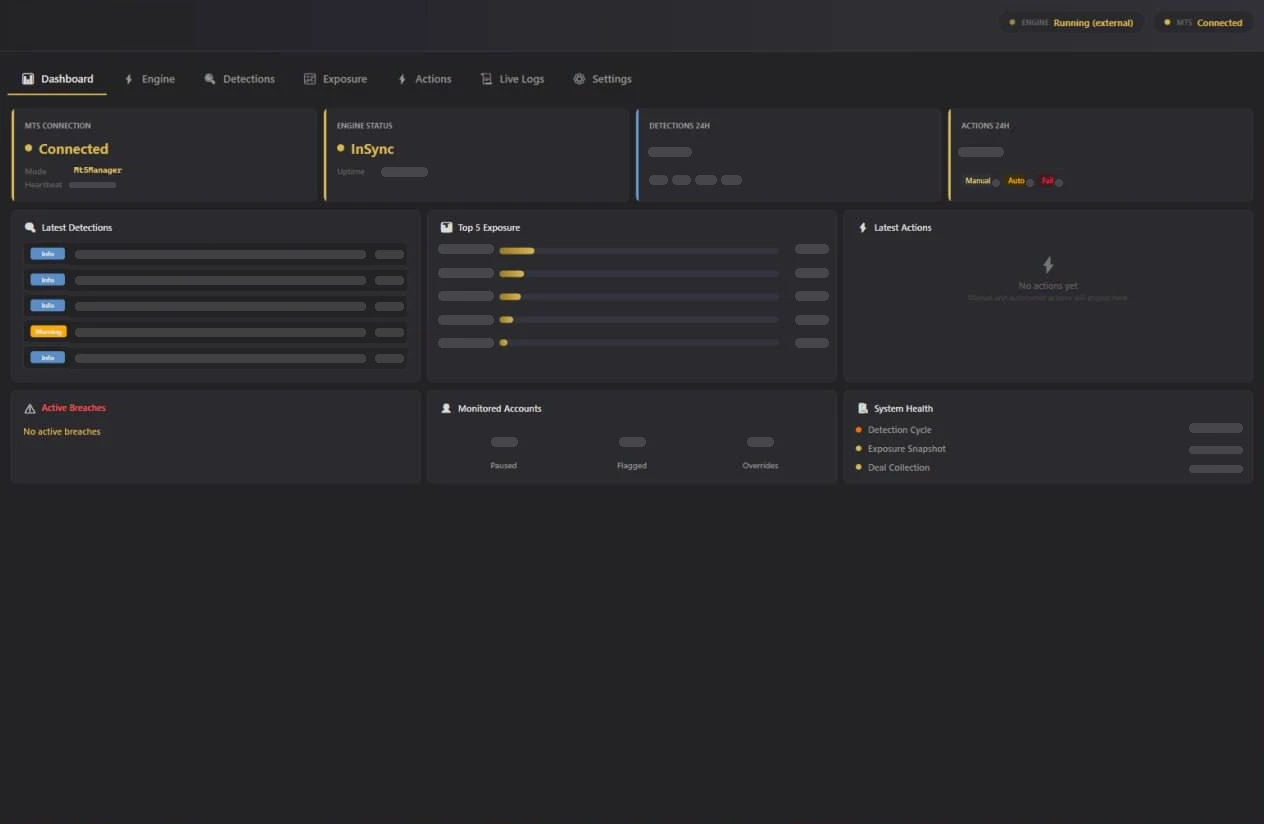
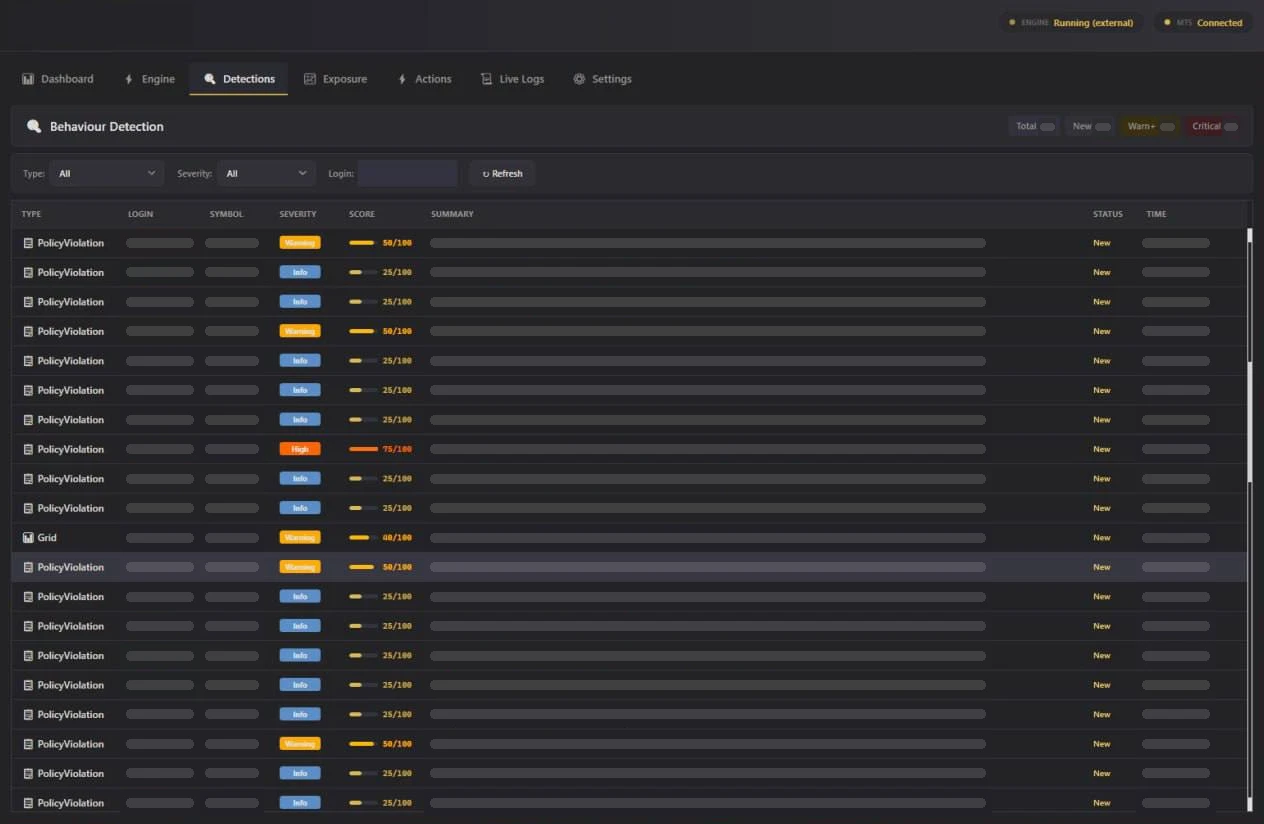
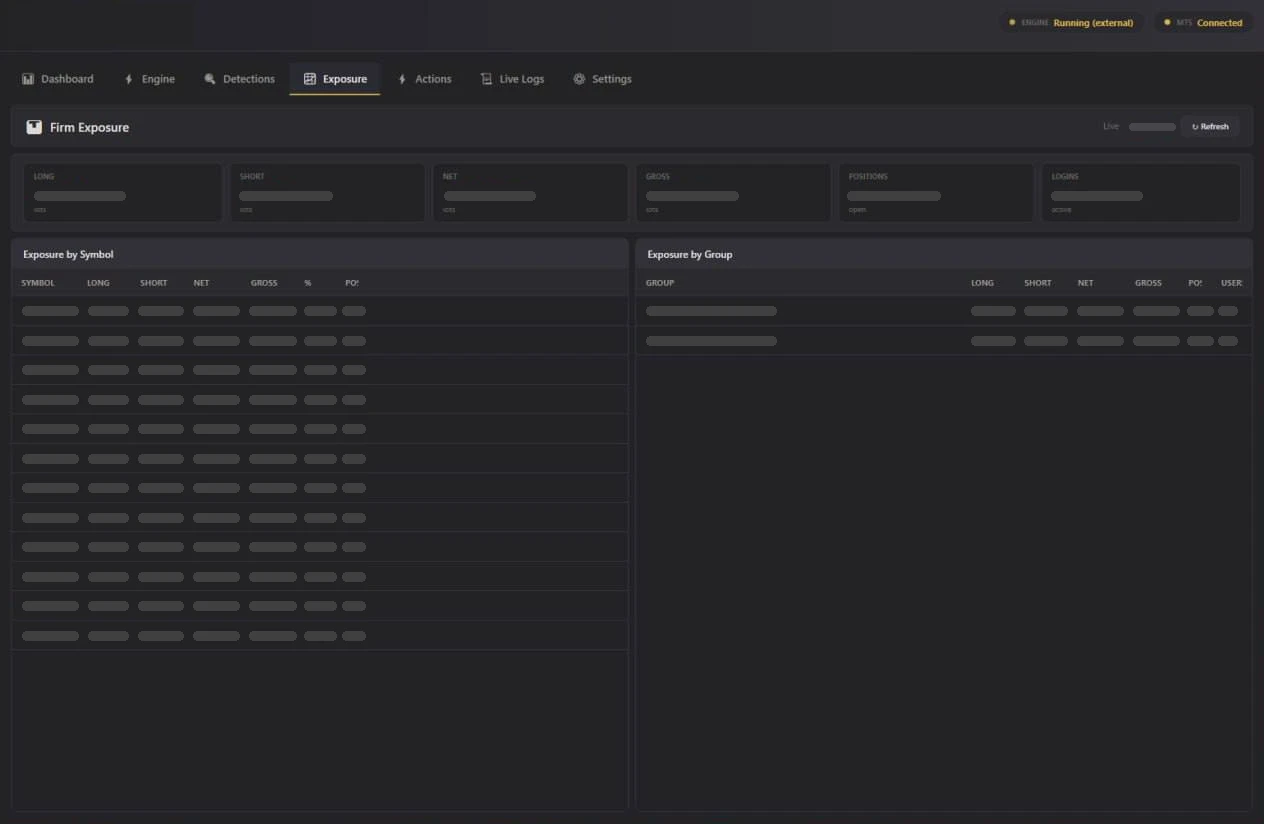
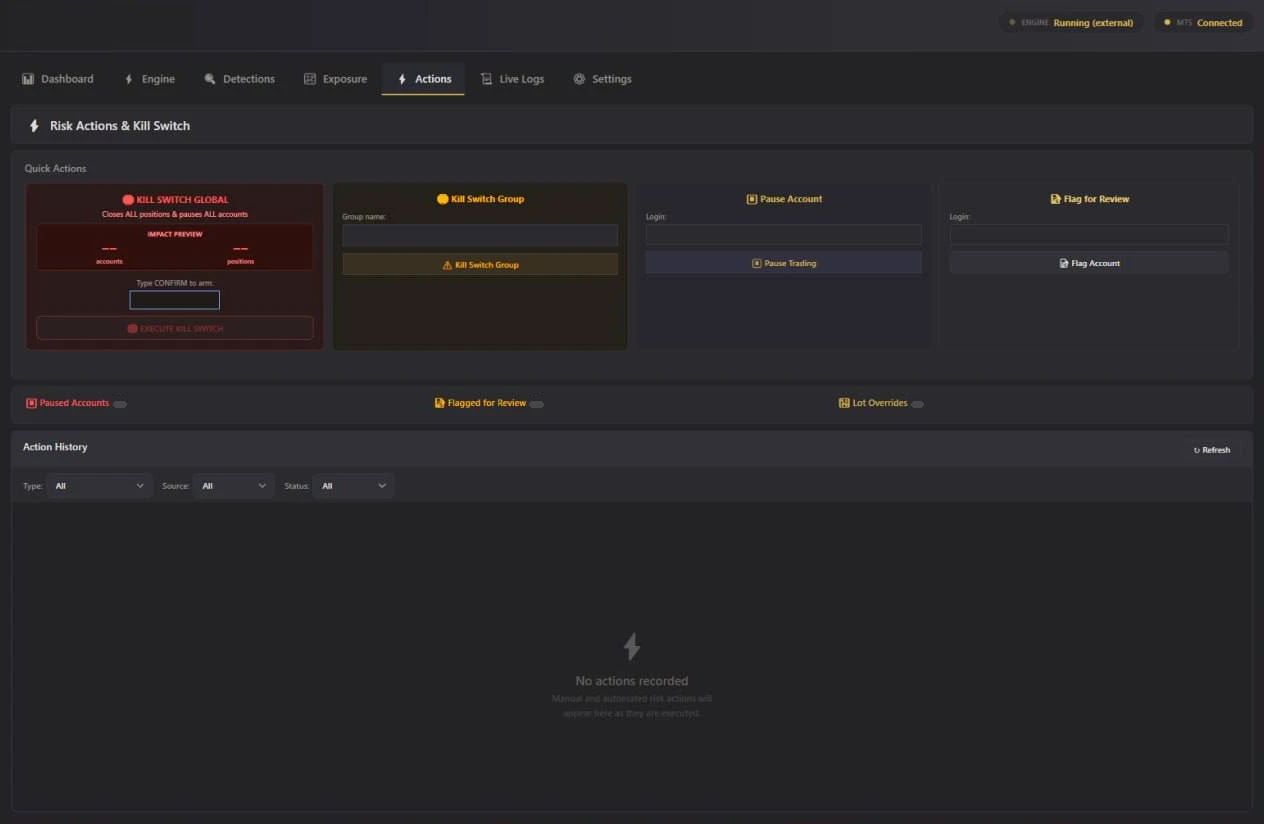
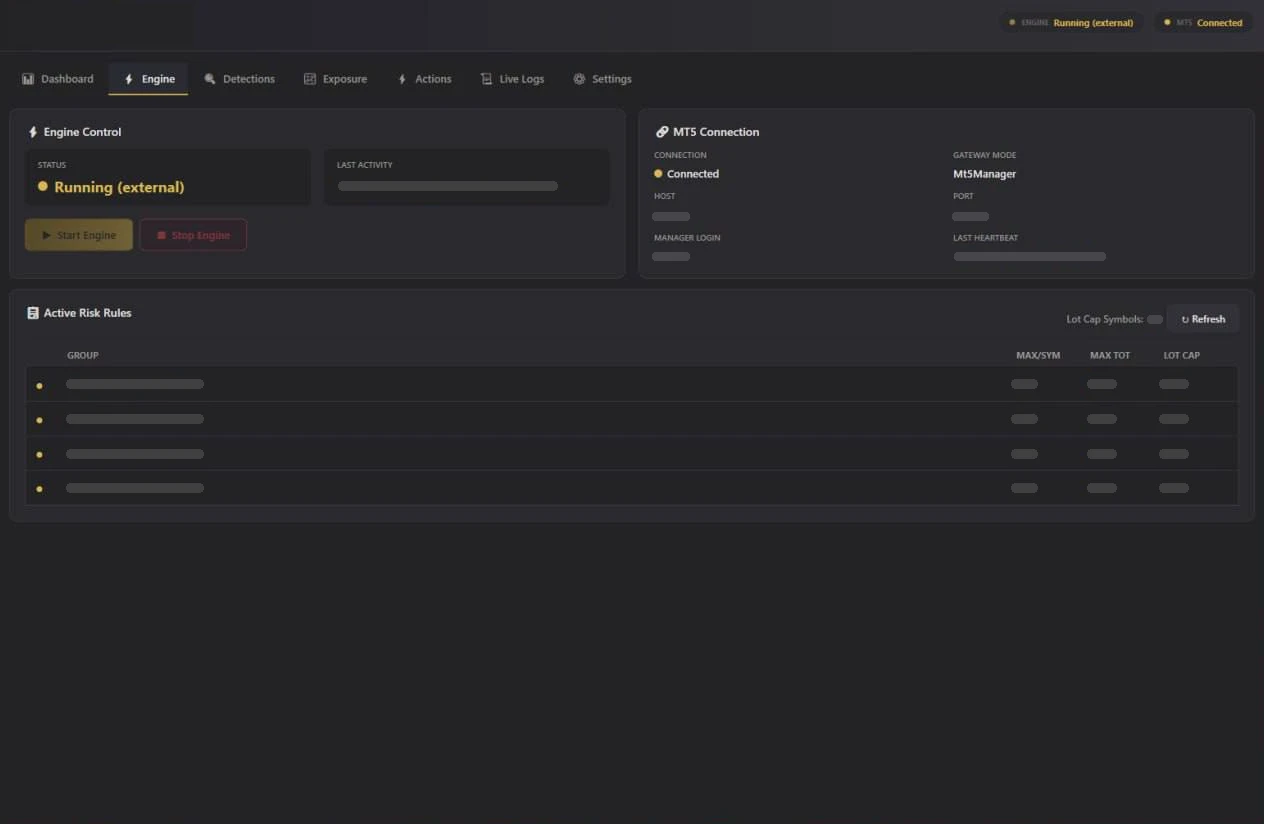
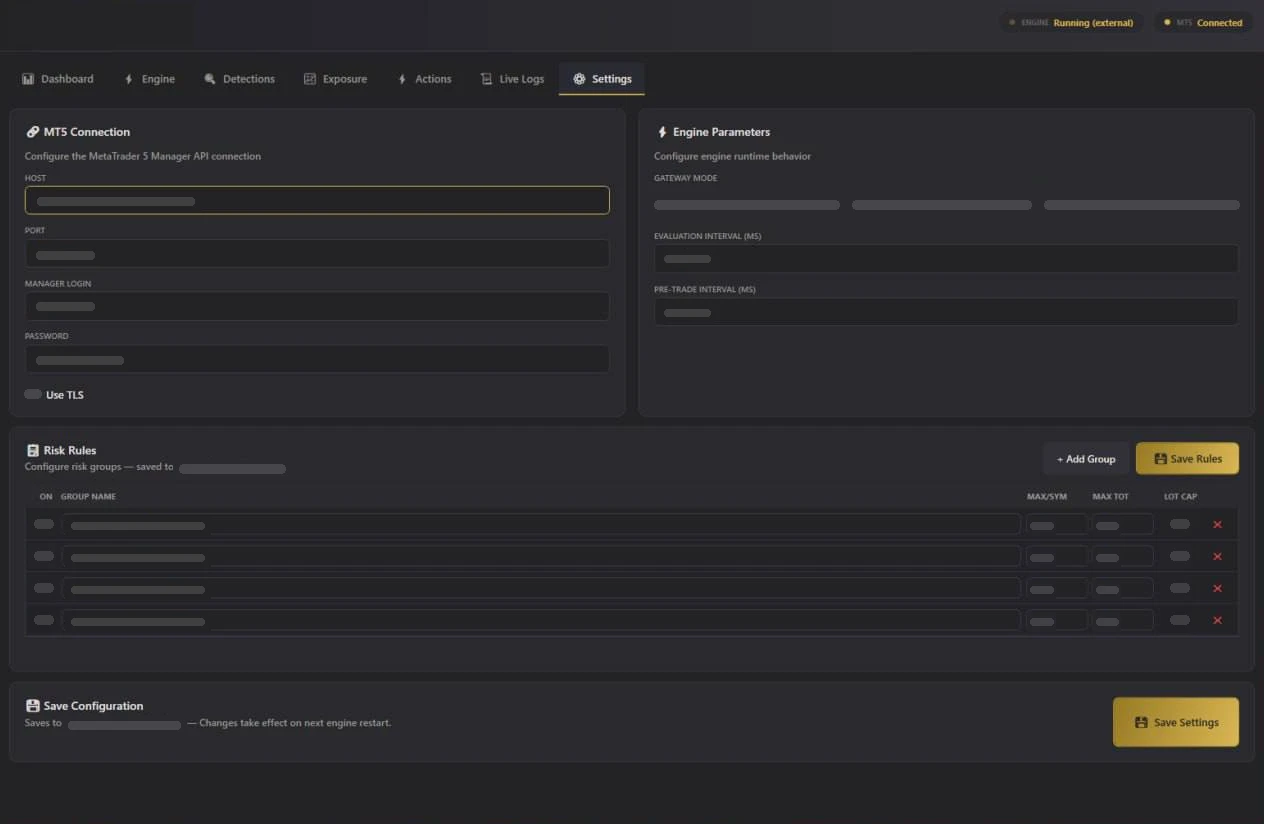
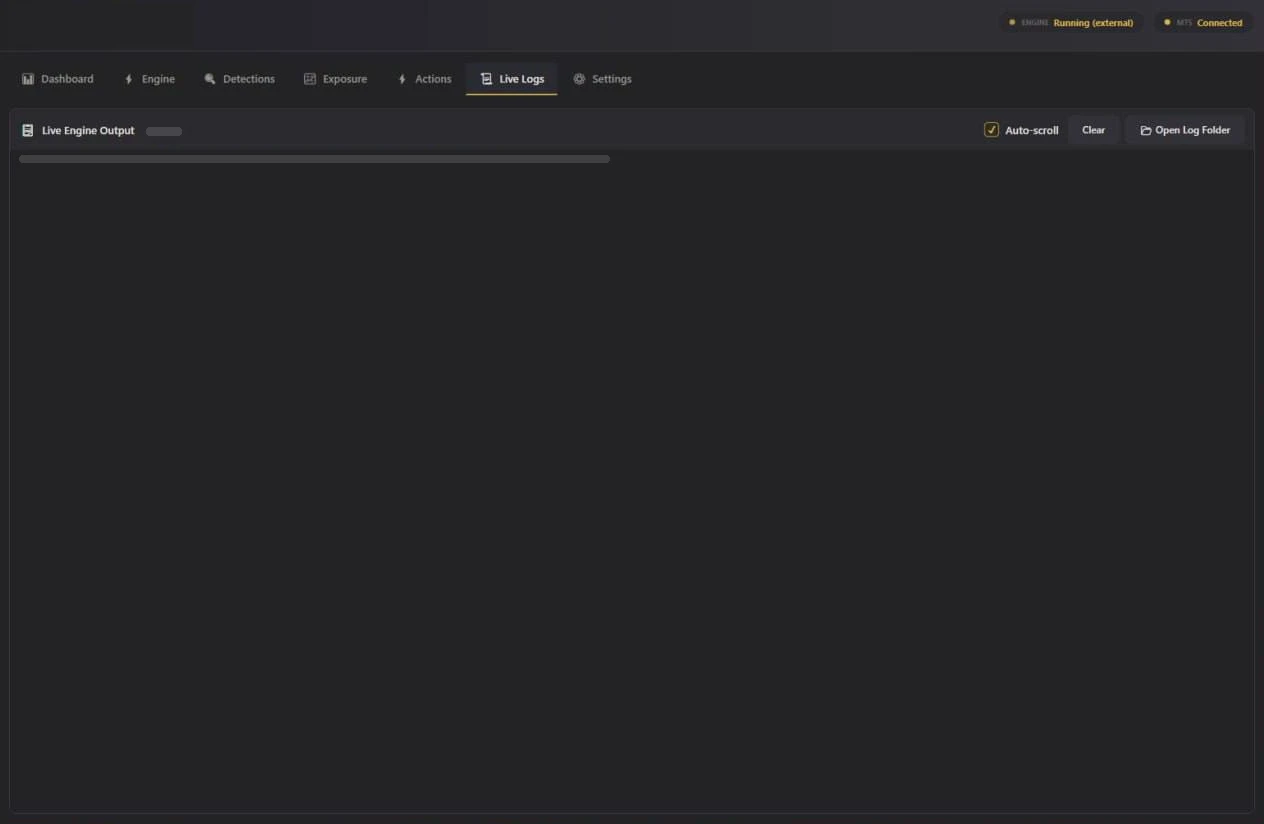
Screen captures of the desktop application, shown after masking. Account identifiers, instrument and group names, amounts, timestamps and descriptions have been masked in the images; interface labels, status indicators, severity badges and scores remain visible. A status, record, score or control visible on screen shows what the interface provides: it is not evidence of a current deployment, of an accurate detection, or that a particular action was carried out.
For a period, an earlier version of this system was operated on the production platform of a professional trading environment, where it automatically enforced limits on the number of positions and on lot size, up to and including closing positions that exceeded them. New requirements, concerning the risk-management rules and the way positions were closed, then led to a further evolution of the system. This operational history relates to that version only.
This reference at a glance.
- A historical custom-engineering reference: a system designed for professional trading operations.
- It is not part of C.G Solutions’ software catalogue: it is not offered for sale, trial or licensing.
- The functions described are those the application provides, as shown on its screens.
- The system was designed to act on activity the platform had already reported; this is not a pre-trade control.
- Nothing shown names or identifies a third party; account identifiers, instrument names and amounts are masked.
AI Project Architect
Exploring a comparable system?
Describe your own requirements and receive a preliminary outline built from our general engineering capabilities — not a copy of any reference.
Need a comparable system?
A similar system would be designed for your own policies, data and operators.